Maybe it’s just being a mom of 4 and pediatric RD but in my world, poop is a perfectly normal thing to talk about because it is loaded with valuable information. Your child’s poop is literally talking to you, you just need a guide to understand what it’s saying!
Before we dive into the nitty gritty poop details, we can’t be shy or squeamish. I have changed thousands of diapers and picked up after dogs with the most active and irritable bowels on the planet. In fact, being the diligent pet owner that I am, I even sifted through dog poop to ensure that my dog had passed the pair of socks that he ate. Yes, you read that correctly. Sigh.
Suffice to say, I’ve dealt with poop, A LOT and my threshold for being grossed out is pretty darn high. All this to say, get on my levels guys! Have no fear and let’s dive in because there are clues in those poos! Poop is a window into your child’s gut health. So pay close attention to your little ones BMs and read on to get some clarity on what it all means.
The Bristol Stool Chart: A Visual Guide to Healthy Poop
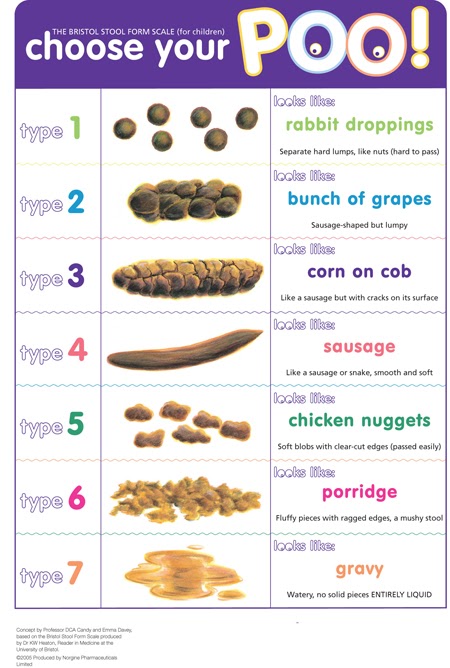
First things first, let’s take a look at the Bristol stool chart. Some saintly people in Britain actually created a guide for us – because who wants to awkwardly go into detail describing their poo to a professional when they can just point and say “Yep, that’s what it looks like”.
This chart is super helpful and will give us a visual to discuss and build upon.
Poop Form: From Constipation to Diarrhea
- Types 1 and 2 tell us there is likely constipation going on. These types of poo may be hard, dried out and difficult to pass.
- If your child’s poop looks like this consistently or your child needs Miralax to have regular bowel movements, I highly encourage you to read Natural Alternatives to Miralax or take my free quiz to uncover the root cause of your child’s constipation. Once we understand what’s driving the constipation, we can figure out how to fix it!
- Type 3 may be a little on the hard side but close to normal.
- Type 4 is the ideal poop – smooth, formed and easy to pass, glides right out.
- Type 5 is a little on the loose side, but may be normal and perfectly fine for some people.
- Types 6 and 7 is where we get into diarrhea territory. It will be liquid and the color may be yellow, brown or green. There will be a definite urgency to go.
- Diarrhea is often caused by food sensitivities, GI inflammation, dysbosis (an imbalance of bacteria in the gut), and viral or bacterial GI infections. The best way to figure out what is causing consistent diarrhea is often stool testing or diet adjustments if food sensitivities are suspected.
How a Healthy Bowel Movement Should Feel
Ideally, bowel movements should be unremarkable. It shouldn’t take a long time to move things out. It should feel complete and there shouldn’t be pain, straining or pushing involved.
If your child is struggling to get poop out, if they spend a lot of time trying to poop with little success, they may have constipation related to slow motility, so stool moves more slowly through the GI tract. This is common among children with autism and can be caused by:
- the gut microbiome
- mitochondrial function
- low vagal tone/being stuck in a stressed, fight or flight state
- lack of fluids or fiber
- withholding (when a child holds in their poop)
It can be tough to distinguish which of these is the primary cause but if you feel this pertains to your child, you can learn much more about how to resolve this kind of constipation in my guidebook, Lasting Constipation Relief for your Child.
How Often Should Kids Poop?
As for frequency, I’m of the opinion that pooping should be happening at least once a day. Here’s my reasoning: children may be eating small meals, or in many cases snacking all day, but nonetheless, they’re eating throughout the day.
Waste is generated each time we eat and should be removed at least once a day because the longer it sits in our colon, the more water gets reabsorbed, and the harder and more difficult it is to pass. This can lead to constipation, straining, hemorrhoids and all sorts of other pains in the butt – pun intended!
Floating Stool: What It Means for Your Child’s Gut Health
Another thing we want to notice is if our child’s poo sinks or floats. If your child’s poop is soft, loose and floating regularly, this may indicate a problem absorbing fats. You may also see oil/grease or mucus. Floater-poo could also be due to a gastrointestinal infection or excess gas. This can be verified with a stool test and/or supplements to aid in digestion.
The Smell of Poo
As for odor, it isn’t going to be great, but it should at least be familiar. An extremely foul smell or an odor that is unusual and worse all of a sudden can be a sign that something’s up in the gut. I often attribute this to some type of GI infection, which can be viral or bacterial. New foods and probiotics can also change the smell of poop but these typically fall within the realm of “familiar” odors.
The Hue of Poo: What Colors are Normal?
Of course, poop is usually brown. It may also be green-ish or yellow/orange-ish, depending on what your child has eaten. Brightly colored veggies can change the color of poo and this is normal.
If your child has eaten beets (maybe in a smoothie or something), tomato products or red food dye, you may see red poop. Red could also point to bleeding in the lower GI tract and this can happen with straining and constipation. In order to overcome chronic constipation, we need to know what’s causing it. I created a free quiz to help you uncover the root cause of constipation and how to get lasting relief for your child.
Black poop could also be due to iron supplements or other medications. I’ve actually seen this after taking Pepto-Bismol. Black licorice or even lots of blueberries can also cause very dark, black-looking stool. Black stool can also be caused by bleeding in the upper GI tract and often looks sticky like tar. If you see this, speak with your doctor.
Poo that is pale in color, yellow or gray is not normal and would warrant a call to your doctor.
What to Do If Your Child Shows Signs of Constipation or Diarrhea
If any of this struck a chord with you, if a flag went up in your head as you were reading and you thought “yep my kid has that”, reach out to me. Poop problems mean there’s something going on upstream in the gut and we can work together to pinpoint why your child is struggling and find the solution!
Welp, would you look at that, it’s poo-thirty and stool school is out of session. Oh man, I’ve gotta cut the crap with these poo jokes… Until next time everybody!